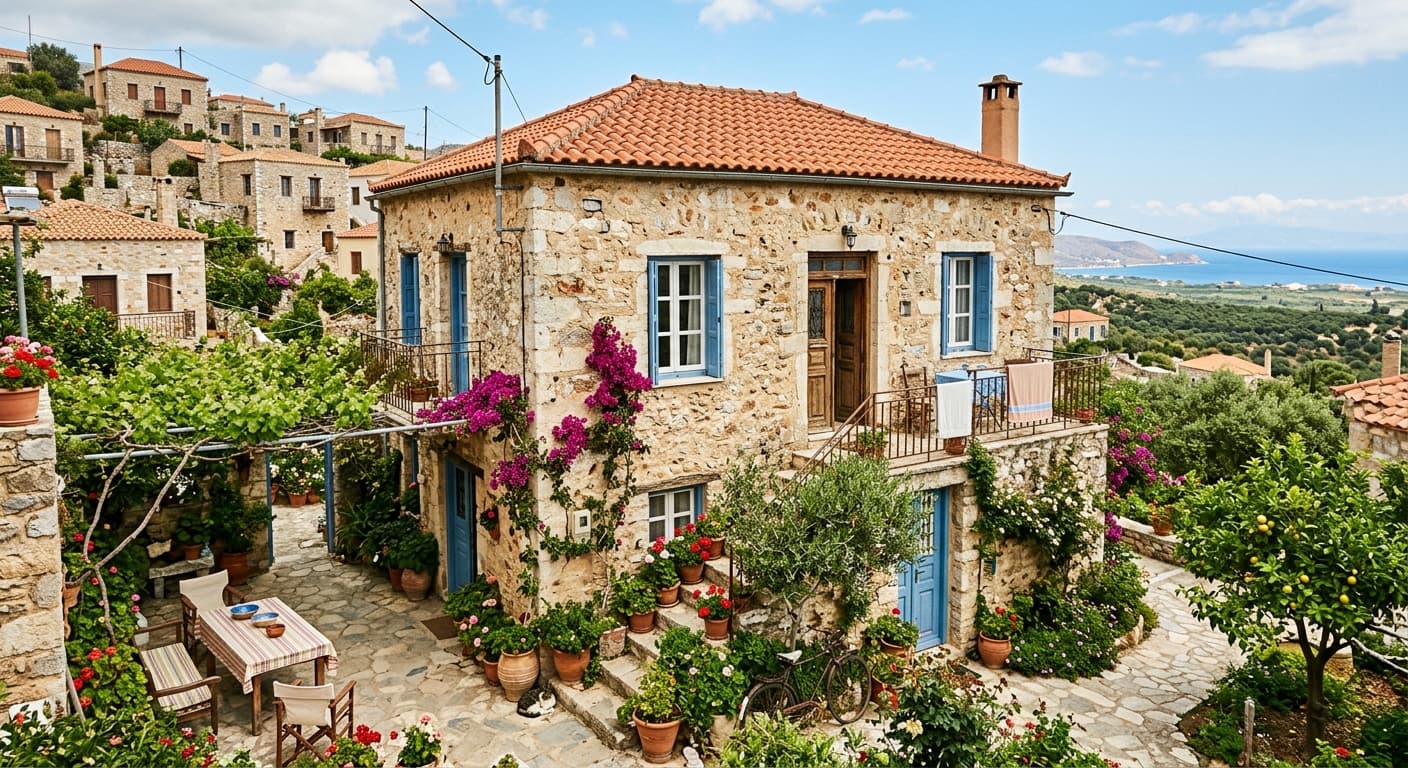
The client's name has been changed to protect his privacy. The case itself is real. The image used with this article is illustrative and is not the property described below.
At the end of July, I received a WhatsApp message from a British property owner who had found my website while looking for insurance in Greece.
I'll call him James.
He had recently bought a house in Chania and wanted something very specific:
building insurance with earthquake cover, but no contents insurance.
That sounds simple.
In practice, it was exactly the kind of case where a few details could make a major difference to the quotation.
The property was a detached house of roughly 60 square metres in central Chania. The original construction dated from around 1960. It had stone walls and a tiled roof.
It had also been fully renovated. Apart from the original stone walls, the roof, interior, plumbing and electrical installation had all been replaced.
So before looking at prices, the first job was to understand the property properly.
Before I quote a property, I need to know what I am actually insuring
For a home-insurance quotation, I normally ask for information such as:
- the construction year,
- the address or postal code,
- the size of the property,
- the type of wall construction,
- the type of roof,
- any important renovation work,
- and how the property is actually used.
Those details are not administrative trivia.
A stone property with a tiled roof is not the same reconstruction risk as a newer reinforced-concrete property with a concrete roof.
The physical characteristics of the building matter because insurance is not simply about the price somebody paid to buy the house.
It is about what it could cost to repair or reconstruct it after a serious insured loss.
Purchase price and reconstruction value are not the same thing
This is one of the most important points for foreign property owners to understand.
A house may have been bought for a certain market price because of its location, land, sea view, condition, demand in the area or many other factors.
That does not mean the same number should automatically be used as the insured value of the building.
The insured value needs to make sense in relation to reconstruction.
In James's case, the stone construction and tiled roof were important because both can affect reconstruction cost. The small size of the property also mattered.
For unusual or difficult-to-assess properties, I may also suggest seeing the building in person before making a final recommendation.
The objective is not to inflate the insured value.
It is to avoid setting a figure that looks economical on paper but may not reflect the real cost of rebuilding the property.
Earthquake cover was important from the beginning
James specifically asked for earthquake cover in his first message.
That told me he had already done some research.
In Greece, earthquake should never simply be assumed to be part of every home-insurance option. It needs to be checked explicitly.
In the quotations I prepared for this property, adding earthquake cover made a significant difference to the premium — close to doubling the cost compared with a basic fire-related option.
That does not make earthquake cover "expensive" or "cheap" by itself. It means the customer needs to understand what protection is being added and decide whether that risk is important to them.
In the options I quoted, earthquake cover carried a 2% deductible calculated on the insured capital.
That deductible is important enough that I would never want a client to discover it only after a claim.
Main residence or holiday home? The classification matters
James lives in the United Kingdom for most of the year and spends around two months in Greece.
In practical terms, the property is his holiday home.
For insurance purposes, however, the important point is not simply how many months somebody is away.
The property needs to be classified accurately according to its actual use — for example, whether it is treated as a main residence in Greece or as a secondary/holiday residence.
Secondary or holiday residences may be priced differently from main residences, depending on the insurance programme.
So I do not reduce this question to "the owner is abroad for ten months, therefore the price is higher".
The correct approach is to describe the use accurately so that the insurer understands the risk and applies the appropriate terms.
Fire protection and security questions need honest answers
Depending on the insurer and the programme, a quotation may include questions about measures such as:
- fire extinguishers or other fire-protection measures,
- a security door,
- an alarm system,
- or other protective features.
These measures are not necessarily mandatory in every case.
But if the insurer asks whether something exists, the answer needs to be accurate.
A customer should not declare that a protective measure exists simply because they think it may improve the quotation.
Materially inaccurate information can affect how a later claim is assessed.
My rule here is simple: describe the property as it really is, and then see what insurance options genuinely fit it.
I prepared three different quotations
Instead of sending James one proposal and telling him "this is the one", I prepared three options.
They ranged from a relatively basic package covering major risks such as fire, flood, explosion and lightning together with earthquake, through to broader cover that also included risks such as glass breakage and water-pipe damage.
Normally, after a detailed discussion, I would narrow the options and recommend the one I believe fits the customer's circumstances best.
In this case, our communication was mainly remote and by telephone, so I preferred to let him see the differences clearly and take some time to consider them.
That also meant explaining something else that can easily be missed: deductibles are not all the same.
One option included an additional general deductible. Another version reduced or removed that additional deductible, while the separate earthquake deductible still remained.
A quotation can look cheaper until the customer understands what part of a loss they would have to absorb themselves.
The quotations were in Greek, so I explained them in English
The official insurance documents and quotations were in Greek.
For somebody living in the UK, that creates an obvious problem.
So I prepared detailed English explanatory versions of the proposals, showing the premiums, main covers, limits and deductibles in a form he could actually study.
Those English documents were for explanation and information. They did not replace the official Greek documents.
This is something I consider particularly important when working with foreign property owners.
A client should not have to choose between three insurance options by looking only at three different prices because the rest of the document is in a language they cannot read.
Then I heard nothing for almost a month
After sending the quotations and explanations, there was silence.
No problem.
I assumed James might still be considering the options, might have found another insurer or might simply have other priorities.
I do not believe that every quotation needs to be chased aggressively.
Then, almost a month later, he contacted me again himself.
He apologised for the delay, told me which option he preferred and said he wanted to proceed.
He selected the broader option that, in my view, was also the most suitable of the three for this particular property, and he chose the version without the additional general deductible.
The separate earthquake deductible still applied.
At the time of writing this case study, the policy has not yet been issued. I am waiting for the remaining information needed to prepare the application.
I prefer to say that clearly rather than turn a real case into a completed success story before it actually is one.
Why this case matters to me
This case was not remarkable because the house was expensive or because the premium was unusually large.
It mattered because somebody in another country found my website, contacted me and trusted me to explain a Greek insurance product for a property he had just bought.
Even if he had eventually decided not to buy insurance through me, I would still have wanted the information I gave him to be accurate and useful.
If the situation were reversed — if I had bought a home abroad and could not understand the local insurance documents — that is exactly how I would want to be treated.
That is also why I do not see English-language service as simply translating a few insurance terms.
The real job is helping the customer understand what the insurer is being asked to cover, how the property is classified, what the insured value means, what the deductibles are and where the important differences between proposals actually are.
Frequently Asked Questions About Holiday Home Insurance in Greece
Can I insure a property in Greece if I live mainly abroad?
Yes. Living abroad does not automatically prevent a property in Greece from being insured.
What matters is that the property's real use and classification are described accurately. Depending on the insurance programme, a main residence and a secondary or holiday residence may be treated or priced differently.
You should also explain how the property is used and whether it remains unoccupied for significant periods so the insurer has an accurate picture of the risk.
Is earthquake insurance automatically included in home insurance in Greece?
Not necessarily.
Earthquake cover should be checked explicitly. Depending on the programme, it may be optional and may carry its own deductible.
In the real case described in this article, the earthquake deductible in the quotations was 2% of the insured capital.
Should I insure my Greek property for the price I paid for it?
Not automatically.
The market purchase price and the reconstruction value of a building are different concepts. The insured building value should be reviewed in relation to what it may realistically cost to reconstruct the property after a serious covered loss.
Construction type, roof type, size and other building characteristics can all matter.
Does a stone house need different consideration for insurance?
It can.
Stone construction and tiled roofs can affect reconstruction cost and may require more careful assessment than a standard modern property.
For unusual properties, an on-site review may also be useful before a final insured value is recommended.
Does a holiday home cost more to insure than a main residence?
It can, depending on the insurer and the programme.
The key point is the property's correct classification and actual use. A secondary or holiday residence may be subject to different pricing or terms from a main residence.
Do security measures or fire extinguishers affect the quotation?
They may be relevant if the insurer asks about them.
The important thing is to answer accurately. Do not declare an alarm, security door, fire-protection measure or other feature unless it actually exists.
Can I receive an English explanation of a Greek home-insurance quotation?
Yes.
For English-speaking customers, I can explain the quotation, covers, limits and deductibles in English and, where useful, prepare an unofficial English explanatory version of the proposal.
The official Greek insurance documents remain the controlling documents.
Need help insuring a holiday home or property in Greece?
If you own a property in Greece and want a clear English-speaking explanation before choosing cover, you can contact me with the basic details of the property.